
Why One AI Agent Isn't Enough (And What to Do Instead)
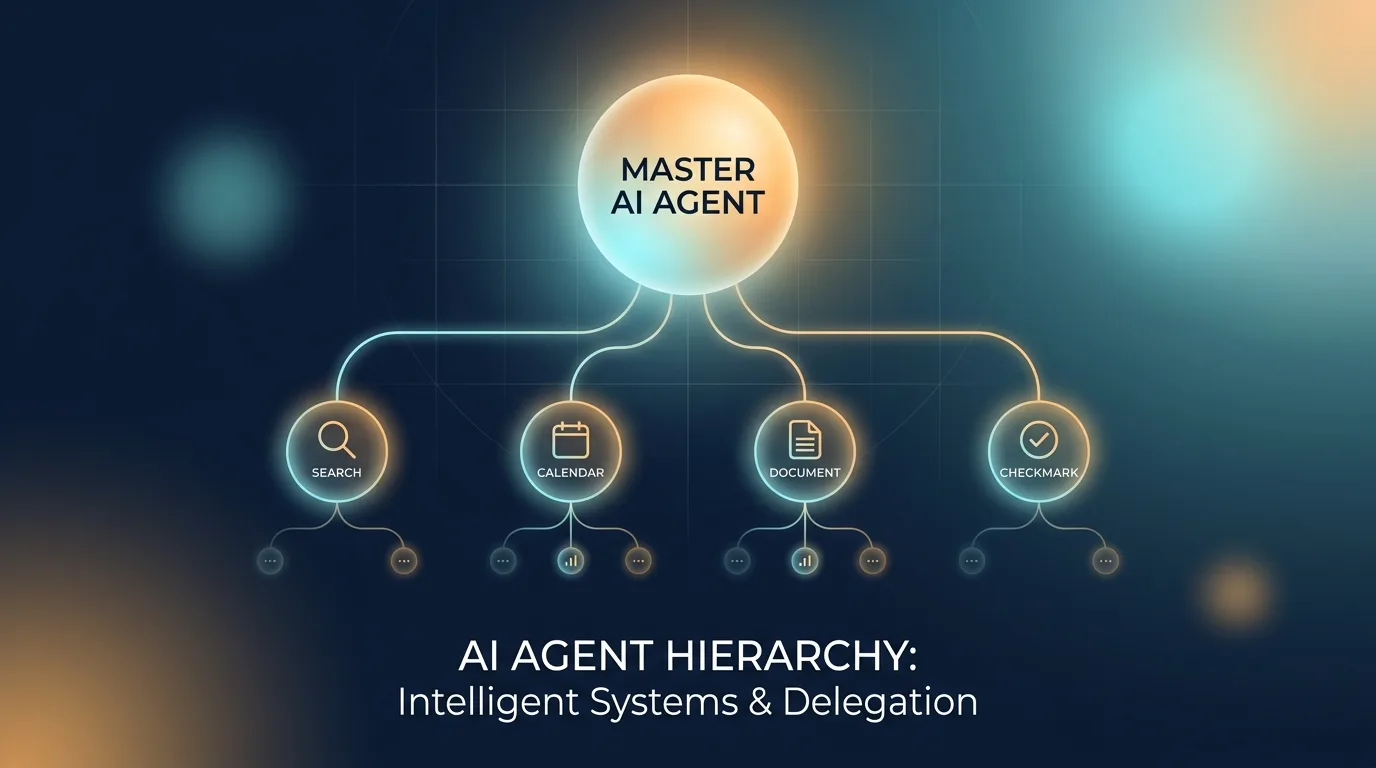
Most people hand one AI agent the whole job and wonder why the output is average. Agent hierarchy fixes that: a team of specialized agents, each with one narrow job, coordinated by a router on top.
- AI agents
- Agent hierarchy
- AI automation
- Workflow automation
If you've built anything with AI, you've hit the ceiling. You write a solid prompt, hand the whole job to one agent, and the result is fine but never great. The instinct is to write a bigger prompt. The real fix is to stop asking one agent to do everything.
That's what agent hierarchy is about. Using a team of specialized agents instead of one generalist. It sounds advanced, but the idea is simple once you see it.
Agents are 200-IQ interns
That's the best way to think about them. Incredibly capable, and completely literal. They do exactly what you tell them, so vague instructions get vague work. The specificity is on you.
A single agent chats with you, uses a few tools, and gives you output. For most things, that's plenty. It's when the task gets complex that one agent starts to slip. Complexity is what decides whether you need a team at all.
A blog post isn't one task
Most people open ChatGPT and type "write me a blog." The results are decent because the models are good. But a blog post isn't one task. It's a title, a meta description, an H1, a set of H2s, keywords, and internal links.
Asking for all of it in one prompt is called one-shotting. No matter how good your prompt is, AI can't be both general and high-quality at once. Ask for everything at once and quality drops.
Split the job across a team
So you split it. One agent researches the topic. One builds the structure. Others handle keywords, headings, and links, one job each. Then a synthesis agent combines every output into one coherent piece. A checking agent reviews the result, catches the weird errors a client would otherwise flag, fixes them, and publishes.
Each agent does one narrow thing well, and the whole system beats the single-prompt approach. That's agent hierarchy. One agent on top, specialists underneath, each with its own tools.
You won't need this every time
Around 95% of what you build runs fine on a single agent. Multi-layer hierarchies are for the genuinely complex cases.
A personal assistant is a good example. Most are one agent with access to five or six tools. But a truly capable one is better split into branches: an organization agent for calendar and email, a messaging agent to confirm things with your contacts, a business agent, even a health branch with its own sub-agents. Each branch carries its own tools.
In that setup, the top agent is basically a router. It takes your input, sees which sub-agents it has, and sends the request to the right one. Sometimes one, sometimes all of them.
How it works in practice
You let one workflow call another. In a tool like n8n, your master agent gets a call-workflow tool pointed at a sub-workflow that's triggered by another workflow. The sub-workflow runs and passes its data back up to the master, no full response path needed.
The clean way to wire the handoff is with a JSON example: define the structure of the data the sub-agent returns so the master knows exactly what it's getting. Not sure how to structure it? Have ChatGPT generate a sample payload.
Where this is heading
Probably one interface. Juggling ten apps is too much friction. It converges on a single interface that calls tools, with a sub-agent structure underneath, all the way down to a specialist whose only job is one narrow thing.
Whatever you build, the rule holds: the narrower and more specific your ask, the better the agent performs. Pair that with solid context engineering and prompting and the output changes completely.
Start with one agent. Reach for a team when the task actually demands it. And either way, keep every single ask narrow.
